


Creative teams often reach for an AI model and then ask what it can do. The more productive order is the reverse: start with the communication problem, decide what a generated sequence needs to prove, and only then open the generator. That single reordering makes prompts sharper, references purposeful, and review meetings less about taste and more about evidence.
The approach below began in music-adjacent work, where rhythm and performance dominate, but it applies to almost any concept development: product demonstrations, explainers, event teasers, and branded storytelling. What stays constant is the idea that a generated clip is a test of a concept, not a finished production, and that the human decisions around it are where the real value lives.
For teams exploring this, Seedance 2.5 is a useful example of a reference-driven model where you can point at a concept and inspect the result.
Read the brief for missing decisions first
A creative brief is usually written for humans, but it can also become the bridge between an idea and a visual test. Before generating anything, audit the brief for gaps. What is the single message? Who appears? What should the viewer notice in the first second? What visual evidence supports the claim the brief is making?
Music work might frame this around rhythm and performance, but the same interrogation works for a product demo or a launch teaser. If those answers are missing, generation will only produce confident-looking confusion, and a review meeting will spend its energy arguing about a problem that a five-minute brief audit could have solved. Fill the gaps on paper first; it is the cheapest revision you will ever make.
Separate what is fixed from what is up for testing
Concept development gets clearer the moment a team marks which elements are locked and which are experimental. The core idea, the audience, and the required subject are usually fixed. Location, lens feel, camera path, colour treatment, and transitions are fair game for experimentation.
If everything changes between versions at once, nobody can explain why one is stronger, and the team ends up choosing by gut rather than by evidence. Run a controlled comparison instead: hold the character and message steady while you test three environments, or freeze the environment and compare camera moves. Changing one variable at a time is slower for a single render and far faster for the project as a whole, because every comparison actually teaches you something.
Write a short visual treatment
A treatment does not need to be long to be useful. Describe the opening frame, how the subject behaves, the setting, the camera movement, the lighting, and the final image. That is enough structure to test whether a concept communicates without pretending the draft is a finished production.
The questions you are answering are practical: does the scene deliver the brief, is the composition plausible, does the tone fit the audience, and is there a clean way into the next beat? A treatment this size takes minutes to write and saves hours of aimless regeneration, because it forces the vague parts of an idea to become specific before a single frame exists.
Review with evidence, not vibes
Concept reviews improve dramatically when everyone reacts to the same artifact. Rather than debating whether an idea sounds cinematic, put a short generated sequence on screen and name the exact decision being tested. Let one reviewer track composition, another brand fit, and another pacing, and keep those notes separate rather than blending them into a single vague verdict.
“Make it more exciting” is almost impossible to act on. “The product is hidden for most of the scene” is a fix. Even when the final piece will be shot conventionally, this discipline tightens the whole approval process, because the team learns to describe problems in terms a creator can actually address. That habit outlasts any single tool.
Handle references and rights deliberately
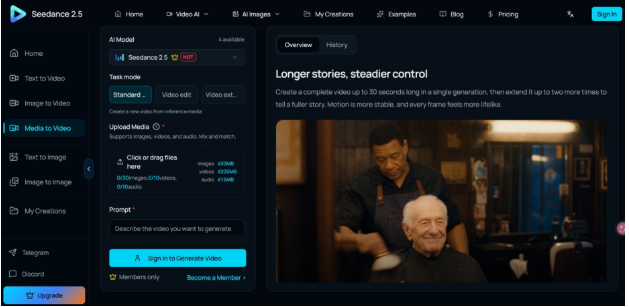
Seedance 2.5 Media-to-Video interface for multimodal reference inputs — courtesy of the official website (https://seedance2-5.com/).

Give every reference a job: a character image for appearance, a location photo for setting, a storyboard for composition, an audio or video clip for timing. Keep approved assets separate from experiments and reuse them when continuity matters, so the concept does not drift each time you iterate. This is exactly the discipline Seedance 2.5 rewards, because its reference-driven, multimodal workflow only stays consistent when the assets you feed it are approved and permission-checked in advance.
Confirm you have permission for the material you feed in, especially recognisable people or brand assets, before a concept moves toward anything public. A concept stage feels informal, but the assets you normalise there tend to survive into the final piece, so it is worth applying the same rights discipline you would use on a finished advertisement.
Turn the winning concept into a production plan
Once a concept survives review, translate it into something a production team can act on. Record the shots it implies, the references that defined it, the decisions that are locked, and the questions still open. A concept that lives only as a generated clip is fragile; a concept written down as a plan can survive the handoff to whoever shoots or edits the final piece.
This step also protects the idea from quiet erosion. Without a plan, the concept tends to change a little at every stage until the finished video no longer matches what the team approved. With one, everyone can check the final result against the same reference and catch drift before it ships.
Keep a decision log for the concept
Concept development generates a trail of choices: why this environment, why this camera move was chosen, why this version won the review. Capturing those decisions in a short log, as they are made, saves the team from relitigating them later and from forgetting the reasoning that made a concept work.
A decision log is also what lets a concept survive a handoff. When the person who develops the concept is not the person who produces the final piece, the log explains not just what was chosen but why, so the intent travels intact rather than eroding at each stage.
The log does not need to be formal. A few lines per decision are enough, provided they capture the reason and not only the result. Over several projects, that record becomes a quiet education in what works for your audience, which is worth far more than any single approved clip.
The takeaway
A strong AI video process ends where good production always ends: a clear, approved result that serves its audience. The model generates possibilities fast; the team still decides which possibility deserves to exist, and then protects that decision all the way to publication.
Used this way, concept development becomes a disciplined loop of brief, test, review, and plan rather than a gamble on a single prompt. The tool widens your options; your judgment is what turns one of them into work worth publishing. Used this way, Seedance 2.5 becomes a concept-testing instrument, turning a written brief into a visual sequence you can actually judge before committing to production.