


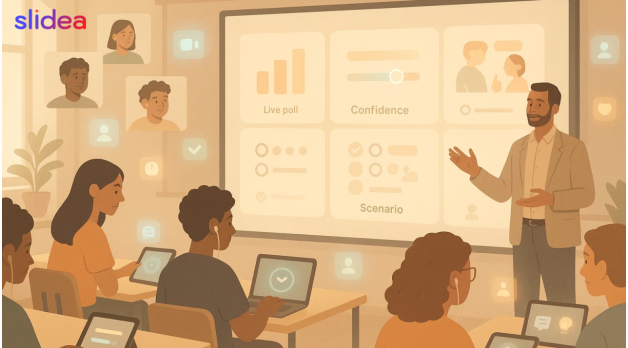
Teaching in 2026 requires more than just standing in front of a screen and talking over slides. Today’s learners want teachers to provide participation, feedback, and clarity throughout the session. That is, every student prefers to be involved in class, whether it is a school classroom, a college lecture, or an online course, rather than being observed. Online assessment tools play an important part in interactive teaching.
Assessments are no longer relegated to a final exam or quiz but are interwoven into the learning process itself, to help teachers understand students in real time and help students stay engaged throughout a lesson. When used thoughtfully, these tools transform passive learning into active participation.
Why Interactive Teaching Matters More Than Ever
Attention spans have reduced, but learning styles have become different. Students are increasingly learning in hybrid classrooms. Students learn in several methods, including listening, doing, and discussing. Interactive learning methods allow students to participate at all stages of the learning process.
Online technologies make it easier for teachers to keep up with this change.
- Allowing teachers
- Check understanding instantly.
- Time yourself based on responses.
- To motivate silent students to join, there should be
- Remove the pressure for “right or wrong” answers.
Rather than waiting until the end of the lesson for evaluation learning, instructors can now assess knowledge.
Begin With Assessment as a Learning Tool, Not a Test
One of the most significant changes in 2026 is the way assessments are viewed. They are no longer only tools for teaching. When used during lessons, they become part of the learning process.
Simple instructional activities, such as questioning for quick polling or a short reflective response, engage learners to actively think about the content. For instructors, these moments are rich opportunities to understand what students grasp and areas where they may remain confused.
This works particularly well with interactive presentation software, because assessment questions occur naturally throughout the class rather than as an interruption.
Use Micro-Assessments During Teaching
A micro-assessment will be brief and simple, taking no longer than one or two minutes. Examples might include:
- Multiple-choice questions
- True or false statements
- Reflections on the Categorizing confidence levels
These brief check-ins help to keep focus and avoid learning gaps in the process. Students will be more likely to participate because there will be no consequences, and professors will be able to provide fast feedback without disrupting class.
Students are learning in 2026, with classes based on these interactions rather than major assessments.
Make Assessment Visual and Interactive
Text-heavy questions can be stressful, especially when the exam sessions are lengthy. Visual formats reduce mental strain involved with tests, making them more engaging.
Charts, icons, or short scenarios inside an interesting presentation tool allow students to absorb topics more quickly. Visual prompts also help different learners overcome communication issues and increase understanding.
For instance, instead of asking, “Do you understand this concept?” a teacher can show a simple scenario and ask students to select how they would respond. In this way, assessment becomes problem-finding, not simple memory.
Create an inviting atmosphere and encourage participation
A challenge commonly associated with learning classes is uneven contribution. Students participate fully while others hold back. Online learning tools offer an opportunity for everyone to participate at the same time without fear of contributing.
Anonymous replies, confidence sliders, and opinion polls allow students to answer honestly. Errors can be fixed without identifying who caused the mistake.
It enhances trust and motivates the students to interact more freely with time.
Use Real-Time Feedback to Adjust Teaching
E-learning and online assessment have one important advantage: quick responses. Unlike traditional learning approaches, learning shortcomings are identified immediately.
When there are multiple student responses identifying an error with the same wrong answer, it will be necessary to describe it from a different perspective. When there are excellent student responses indicating understanding, then it will be possible to continue with the lesson.
All these make teaching more flexible and student-centered, which becomes very useful for an interactive classroom.
Blend Assessments into Interactive Presentations
Assessments are most successful in 2026 when they are integrated into the lesson rather than separate activities. Adding questions directly into interactive presentation software improves flow and engagement.
If students know that at intervals, they will be asked to respond, they remain attentive throughout the presentation. This also minimizes passive screen time and encourages active listening.
After presenting first and then evaluating, teachers can combine explanation with participation to maintain students’ interest.
Support Different Learning Styles
Not every student demonstrates their understanding the same way: some prefer selecting options, some enjoy writing in a short format, and some understand better with the help of images.
Online assessment tools provide a chance to change question formats. A instructor can address multiple learners in a single session. This is an inclusive approach that will help to improve overall learning outcomes while also reducing content among students who are uncomfortable with standard assessment methods.
Use Assessment Data Thoughtfully
While data has importance, the goal is understanding rather than monitoring. By 2026, teachers were focused on patterns rather than individual faults. Assessment results are used to prepare lessons, hold revision sessions, and provide further support as needed.
It also helps students themselves to reflect on and take responsibility for their learning by having summarized feedback shared with them.
Create a Safe and Supportive Learning Environment
The interactive assessments work properly in classrooms where mistakes are regarded as opportunities for learning. Assessments become more meaningful when students feel safe to answer honestly.
Teachers reinforce this by acknowledging effort, discussing common misunderstandings, and emphasizing growth over scores. Over time, students become more confident participants in the learning process.
Final Thoughts
Online assessment tools have become essential for interactive teaching in 2026, not because of the technology alone, but because of how they support better learning experiences. When assessments are used thoughtfully, they help teachers teach better, and students learn more actively.
In other words, by including short evaluations into the teaching process, using visual and interactive forms, and responding to results in real time, educators may create classrooms that are engaging, open, and productive.
Engaging education focuses on teaching better, listening carefully, and including all learners rather than doing much.