


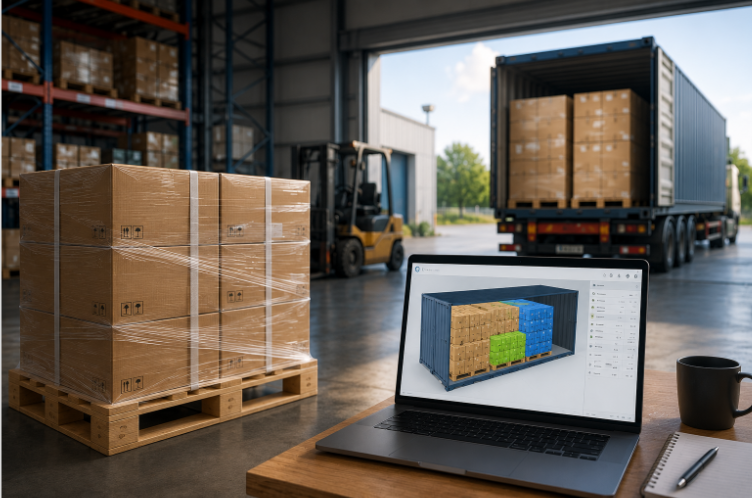
Freight costs rarely rise because of a single major mistake. More often, the problem is a collection of small inefficiencies that go unnoticed for months or even years. One of the most common examples is pallet loading.
When pallets are loaded without a clear strategy, businesses end up transporting space, increasing the risk of product damage, and paying for additional shipments that could have been avoided. In today’s competitive logistics environment, even small improvements in loading efficiency can deliver measurable savings.
For manufacturers, distributors, and logistics providers, optimizing pallet loading is no longer just a warehouse task. It has become a critical part of supply chain performance.
Why Pallet Loading Matters More Than Most Companies Realize
Many organizations focus on carrier rates when trying to reduce transportation expenses. While negotiating better rates can help, there is often a larger opportunity hidden inside the trailer itself.
If a company ships 100 truckloads per month and improves trailer utilization by just 10%, it may eliminate several shipments annually. That translates into savings on transportation, labor, fuel, and handling.
Effective pallet loading delivers several advantages:
- Higher trailer and container utilization
- Lower freight costs per shipment
- Reduced product damage during transit
- Improved warehouse efficiency
- Better delivery reliability
The key is understanding that cargo loading is not simply about fitting products into available space. It is about balancing stability, safety, weight distribution, and capacity utilization.
Common Pallet Loading Mistakes That Increase Costs
Even experienced warehouse teams encounter issues that affect load quality and transportation efficiency.
One of the most frequent mistakes is uneven weight distribution. Heavy products concentrated on one side of a pallet can create instability during transport and increase the likelihood of damaged goods.
Another common problem is product overhang. Boxes extending beyond pallet edges are far more likely to be crushed during handling. What appears to be a space-saving tactic often results in costly claims.
Stacking patterns also deserve attention. Interlocking patterns can improve stability, while column stacking may be better for certain products. Applying the same approach to every shipment is a common and costly mistake.
Efficient pallet loading is always a balance between maximizing space and maintaining load integrity.
How EasyCargo Load Planning Software Helps Optimize Pallet Loading
As shipment complexity increases, manual planning quickly reaches its limits. Warehouse managers often rely on spreadsheets, rough calculations, or trial-and-error methods that consume valuable time and leave unused space.
This is where EasyCargo 3D load planning software for pallet loading and cargo loading optimization can provide a significant advantage.
Modern pallet loading software calculates efficient loading arrangements based on cargo dimensions, weight restrictions, stacking rules, and vehicle specifications. Instead of relying on estimates, planners can visualize the entire load before physical loading begins.
| Manual Planning | Software-Assisted Planning |
| Relies on estimates | Uses calculated optimization |
| Time-consuming | Faster planning process |
| Higher risk of errors | Improved accuracy |
| Limited visibility | Full 3D visualization |
| Difficult comparisons | Multiple loading scenarios |
For logistics teams handling diverse shipments, load planning software helps uncover opportunities that are difficult to identify manually while creating a more consistent planning process.
Maximizing Space Without Compromising Stability
Increasing load density should never come at the expense of cargo safety.
One proven technique is strategic pallet orientation. In some trailer configurations, alternating pallet directions can increase capacity and reduce wasted space.
However, more space utilization does not automatically mean a better load. Experienced logistics professionals also consider:
- Axle weight restrictions
- Center of gravity
- Load securing requirements
- Forklift accessibility
- Product fragility
Visualization tools help identify these issues before loading begins, reducing delays and improving overall efficiency.
Looking Ahead: Freight Efficiency in 2026 and Beyond
Supply chains are becoming more complex, customer expectations continue to rise, and transportation costs remain unpredictable. In this environment, businesses can no longer afford to treat pallet loading as a routine operational task.
By combining proven pallet loading principles with modern pallet loading software and load planning software, companies can increase trailer utilization, reduce transportation costs, improve delivery reliability, and minimize product damage.
The technology already exists. Businesses that optimize every available cubic meter today will be in a stronger position to control costs and remain competitive tomorrow.