


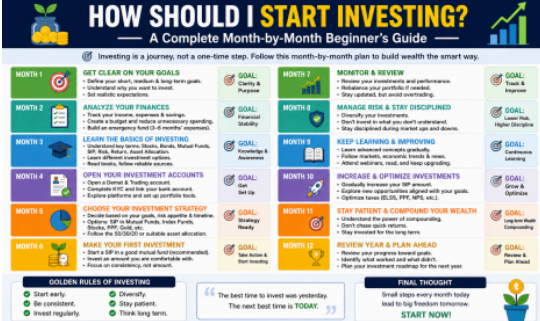
This article will explain why most individuals procrastinate when it comes to investing and reveal that the time to do so is now. It will outline how to get started with investing step by step and provide a monthly plan that a total novice can follow to start building their finances effectively from day one.
Why Starting to Invest Is the Most Important Financial Decision You Will Ever Make
While it may be tempting to store your savings in a bank account, here is a hard fact — it actually kills your finances. At an annual inflation rate of 6-7%, your savings erode at an incredible speed every year. If you keep your ₹1,00,000 in a bank for twenty years under a 7% inflation rate, it will only amount to ₹3,86,000.
Making money from investments is not about becoming instantly wealthy overnight. It is about making your investments perform as well as you do, leaving the work to compounding interest to earn money for you automatically. The sooner you start, the better compounding performs on your behalf in a decade or two.
Month 1: Financial Self-Audit and Goal Setting
The first month isn’t about stock selection; it is about determining where you are today and where you want to be in the future.
Month 1 Actions:
- Determine your monthly income, fixed expenditure, variable expenditure, and discretionary spending
- Determine how much money you are able to save each month comfortably without compromising too much on your current lifestyle – even Rs 500 or US$ 50 each month counts as a good beginning
- Set yourself 3 different financial objectives, one for each period of 1-3 years, 3-7 years, and beyond 7 years
- Check your credit score – a healthy credit score in excess of 750 unlocks more financial opportunities for you
- Create a dedicated savings account or sub-account for your savings in order to keep them separate from your day-to-day spending
The key takeaway from Month 1 is that you don’t require much money to begin investing; all you need is the discipline.
Month 2: Learn the Basic Investment Vehicles
Entering into a market where you don’t know what you are buying can be called gambling. This is why you need to spend the second month learning about the primary instruments that you are working with.
Stocks (Equities)
When you buy shares, it means that you become the partial owner of the company. As long as this company is growing and making money, you make more. Therefore, buying stocks offers you the highest profit potential, although it is also extremely risky because prices fluctuate.
Mutual Funds
A mutual fund collects funds from thousands of investors and invests these funds into various stocks, bonds, or combination thereof, under management of an expert. For starters, mutual funds represent one of the safest ways to enter the market.
Index Funds & ETFs
The index fund is a type of mutual fund which replicates performance of certain indices such as the Nifty 50 or the S&P 500 index by investing equally into every asset of the index. Unlike actively-managed funds, index funds do not employ any experts; therefore, their fee (also known as expense ratio) is minimal. On average, more than half of actively managed funds do not exceed the performance of the index fund. Thus, it becomes clear why index funds are the first thing that every beginner investor should consider.
Bonds/Fixed Income
When you purchase bonds, it means that you give money to a government or business in return for periodic interest payment plus repayment of the face value on maturity. Bonds carry less risks and bring lower returns when compared to equities.
Public Provident Fund / Fixed Deposits (Indian-specific)
These are risk-free investment products backed by the government; hence, suitable for the conservative type of investments.
Month 3: Understand Risk Tolerance and Asset Allocation
One of the most ignored processes when it comes to investments is self-assessment regarding your capacity to handle risk.
Think about these questions:
- If you see your ₹1,00,000 worth of assets fall to ₹70,000 at any point in time, will you become fearful and sell off the position or remain invested?
- Are you financially secure or unstable?
- How far are you from your retirement age?
Depending upon your answers, you will be able to figure out an ideal asset allocation for yourself — that is, the proportion of equity vis-a-vis fixed assets in your portfolio:
| Risk Profile | Equity Allocation | Debt Allocation | Suitable For |
| Aggressive | 80–90% | 10–20% | Age 20–35, long horizon, stable income |
| Moderate | 60–70% | 30–40% | Age 35–50, medium horizon |
| Conservative | 30–40% | 60–70% | Age 50+, short horizon, low risk appetite |
A simple and widely used rule of thumb for equity allocation is 100 minus your age. A 30-year-old would hold 70% in equities and 30% in debt. As you age, gradually shift toward safer instruments.
Month 4: Open Your Investment Accounts
Theories without execution are meaningless. Month 4 is all about execution — opening all the accounts that allow you to trade legally and effectively.
For Indian Investors:
Demat and Trading Account: Required for stock trading or mutual funds (ETFs). One can get an account with a SEBI registered broker (Zerodha, Groww, or Upstox are good options for beginners).
Mutual Fund Account: Accounts for mutual fund investing can be made via the websites of mutual fund companies or MF Central, as well as through applications such as Coin from Zerodha and Groww.
Know Your Customer (KYC) Process: This must be completed through a PAN/Aadhaar based system — one time requirement for investment across all market segments in India.
For International Investors:
- Open a broker account through a cheap broker
- Choose brokers that provide zero-commission trading and have access to index funds and ETFs
- First choose a tax-effective retirement plan such as 401k in America, ISA in Britain, and National Pension System in India before choosing taxable ones.
Month 5: Make Your First Investment With a SIP
A SIP into an index fund or a large cap equity mutual fund is probably the best way to start for every new investor.
In a SIP, you instruct yourself to make an investment in a fixed amount of money, such as ₹2,000 or ₹5,000, on a particular date in each month, come rain or shine. In one stroke, the practice removes two major errors made by most new investors:
- Market Timing: trying to guess the perfect time to make an investment, which can never happen
- Emotional Investing: making impulsive investments in euphoric markets and panic selling in bad markets
There is a market behavior called Rupee Cost Averaging that you exploit here. When the market falls, your fixed amount will be able to purchase more units since prices have fallen. When the market rises, your units grow in value. The effect over time smoothes out both prices and your costs.
A simple first portfolio for a beginner with ₹5,000/month:
- ₹3,000 → Nifty 50 Index Fund (large-cap equity)
- ₹1,000 → Nifty Next 50 Index Fund (mid-cap exposure)
- ₹1,000 → Short-term Debt Fund or PPF (stability and balance)
Month 6: Learn to Read Your Portfolio Without Obsessing Over It
Month 6 is when SIPs start running, and the portfolio starts getting built. Now comes the psychological test – resisting the urge to check it every day.
The daily monitoring of portfolio is the death knell for wealth accumulation. Markets move all the time; occasionally, markets can be extremely volatile, and investors who keep themselves updated about the developments tend to take hasty decisions, which ultimately end up hurting them. Research studies have invariably proved that investors who do not look at their portfolios daily generate better returns than those who do.
Good portfolio monitoring practices:
- Monthly reviews to ensure that your SIPs are running properly
- Quarterly analysis of performance of your mutual fund portfolio by comparing your fund performance against the relevant benchmark index rather than against advice from others
- Once a year, review the allocations across various asset classes and, if the equity allocation has deviated significantly from the desired allocation (like from 70% to 85%, because the equity markets have been performing well), sell off equities and invest them in fixed-income products
The Power of Compounding: Why Time Is Your Greatest Asset
No article on investing is complete without a concrete illustration of compounding — the phenomenon Albert Einstein allegedly called the eighth wonder of the world. If you also have questions like “I’m 25 and Earning ₹30K a Month How Should I Start Investing for Long-Term Growth?” don’t worry let me explain
Consider two investors, Arjun and Priya:
- Arjun starts investing ₹5,000 per month at age 25 and stops at age 35 (10 years total, ₹6 lakh invested)
- Priya starts investing ₹5,000 per month at age 35 and continues until age 60 (25 years total, ₹15 lakh invested)
Assuming a 12% annual return:
- Arjun’s portfolio at age 60: approximately ₹1.76 crore
- Priya’s portfolio at age 60: approximately ₹94 lakh
Arjun invested less than half the money Priya did — but started 10 years earlier and ended up with nearly double the wealth. That is the terrifying, beautiful mathematics of compounding, and it is the single greatest argument for starting today rather than waiting for the “right time.”
Follow Successful Business Personalities for Real-World Financial Inspiration
One of the least recognized but extremely effective methods of fast-tracking your financial knowledge includes following successful Indian entrepreneurs and business personalities, who freely talk about their mindsets towards money, investments, and creating wealth. The information that comes from reading books and attending seminars and tutorial sessions is great. But watching real, successful people think and act with money is priceless.
Some of the popular people that you should start following right now in order to learn and inspire yourself include:
- Saniya Chandok: A budding and young business personality, whose entrepreneurial story and approach towards money will provide you with the necessary inspiration to dive deeper into investing. You can say Saniya Chandok Age and knowledge are really above the rest of the people.
- Aman Gupta — A co-founder of boAt, one of the top Indian Direct-to-Consumer (D2C) brands. With his shark-tank approach towards creating a brand from scratch, bootstrapping it, and developing a solid business on low budget, Aman can teach us a lot as new investors
- Ashneer Grover — The founder of BharatPe and one of the most vocal commentators on the Indian startup scene, fintech, and finances. His brutal truths about valuations, fundraising, and wealth creation can be learned nowhere else but on the internet
The process of following these people on social media websites like LinkedIn, Instagram, and YouTube provides you with practical financial insight that is backed by real-life experience of successful entrepreneurs. Watching how
successful people frame risk, evaluate opportunities, and build wealth over time trains your financial instincts in a way that passive reading simply cannot.
Common Mistakes First-Time Investors Must Avoid
Even well-intentioned beginners derail their wealth-building journey with these recurring errors:
- Chasing past returns — A mutual fund that returned 40% last year is not guaranteed to repeat that performance. Past returns do not predict future results
- Ignoring expense ratios — A 1% difference in annual fees may seem trivial but costs you hundreds of thousands of rupees over a 20-year period due to compounding
- Investing money you need soon — Never invest in equities money you will need within 2–3 years. Short-term market downturns can wipe out capital right when you need it
- Putting all eggs in one basket — Concentrating your entire portfolio in one stock, sector, or geography creates catastrophic risk. Diversification is not just a strategy — it is survival
- Stopping SIPs during market crashes — Market crashes are not disasters for long-term investors. They are sales events where you buy more units at lower prices. The worst thing you can do is stop your SIP when markets fall
Conclusion: Your Wealth Journey Begins With a Single Step Today
It is not a privilege meant for only people with loads of money; it is an art practiced by people irrespective of their financial status. The timeline described in this guide for six months is realistic and effective, giving a step-by-step guide that makes one overcome the dilemma of not knowing where to begin investing.
What needs to be taken away from this is that time in the markets is always more beneficial than timing the markets. Any delay will mean missing out on the benefit of compounding that you cannot recoup. An SIP of ₹2,000 starting from age 25 will help you a lot more in life than an SIP of ₹10,000 starting from age 40, just due to the effect of time.