


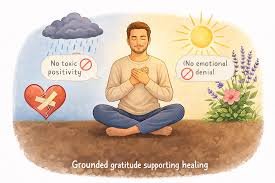
When Gratitude Gets Misunderstood
Gratitude has a branding problem. A lot of people hear the word and immediately picture a forced smile, a journal full of polished thoughts, or someone insisting that everything happens for a reason while your life is clearly on fire. No wonder the idea can feel irritating when you are stressed, grieving, burned out, or simply having a bad week.
But real gratitude is not a performance. It is not emotional censorship. It is not pretending your pain would disappear if you just had a better attitude. In fact, gratitude usually becomes more honest, and more useful, when you stop treating it like a mood you have to earn. That is true even in practical parts of life. For example, sorting through bills with household budget software might bring up relief, shame, hope, frustration, pride, and fear all at once. Gratitude in moments like that is not about minimizing stress. It is about admitting, “This is hard, and I can still notice what is helping me get through it.”
That matters in everyday life, especially in ordinary stressful places like family conflict, work overload, health worries, or money pressure. A lot of emotional growth does not happen during some peaceful mountain retreat. It happens while you are answering emails, making dinner, sitting in traffic, or trying not to panic over a bank balance. Gratitude is valuable there, not because it turns those moments into something beautiful, but because it keeps you connected to what is still steady, useful, and real.
Gratitude Makes More Sense When It Sits Next to Reality
A healthier way to think about gratitude is that it works best beside discomfort, not instead of it. You do not need to wipe out anger to appreciate support. You do not need to silence sadness to recognize love. You do not need to deny disappointment to notice that one part of your life is still holding steady.
This is where many people get stuck. They think gratitude requires emotional neatness. It does not. Human feelings are messy by design. You can be deeply grateful for a friend who showed up for you and still feel heartbroken about why you needed them. You can appreciate your paycheck and still resent the exhaustion that comes with earning it. You can love your family and still need a break from them.
That kind of mixed emotional experience is normal. Research on gratitude suggests it is often connected with social emotions like connectedness, but it does not erase other feelings just because gratitude is present. This overview from Greater Good helps explain why gratitude is better understood as part of a wider emotional life, not a replacement for it.
The Opposite of Gratitude Is Not Complaining
One reason forced positivity feels so hollow is that it frames any struggle as failure. If you are not thankful enough, then supposedly you are doing life wrong. That is a terrible standard, and it pushes people into self judgment instead of self awareness.
Complaining is not always the enemy of gratitude. Sometimes complaining is information. It can reveal what hurts, what is unfair, what needs to change, or what boundary you have ignored for too long. If your version of gratitude makes you tolerate what should be confronted, it is no longer gratitude. It is avoidance dressed up as wisdom.
Real gratitude can actually sharpen your judgment. When you clearly see what is good, you also become clearer about what is not. Appreciation can make your standards stronger. If you know what genuine care feels like, you are less likely to normalize neglect. If you understand the value of rest, you may stop glorifying constant depletion. If you recognize the gift of being treated with dignity, you may become less willing to stay in spaces where that dignity is absent.
Why Authentic Gratitude Feels Different
Authentic gratitude has texture. It is specific. It sounds less like a slogan and more like a confession. Not, “I am grateful for everything,” but, “I am grateful my sister answered the phone when I was spiraling.” Not, “I should be thankful,” but, “I did not fix the whole problem today, but I made one honest step.”
That honesty matters. Recent psychological research has found that perceived honesty in gratitude is closely tied to better personal and relationship well being. In other words, gratitude seems to matter more when it feels sincere than when it feels polished. You can read the abstract for that research on PubMed’s record of the study.
This rings true in real life. People can usually tell the difference between gratitude that is alive and gratitude that is recited. One invites connection. The other creates distance. A forced thank you often lands like obligation. A truthful one lands like trust.
What Gratitude Looks Like on a Hard Day
On a difficult day, gratitude may be tiny. It may be almost embarrassingly small. That does not make it less real.
- It might be the coffee that stayed hot long enough to finish.
- It might be the coworker who gave you five minutes of patience.
- It might be the fact that your body got you through the afternoon.
- It might be the bill you paid, the walk you took, the text you finally answered, or the moment you did not abandon yourself.
Notice what all those examples have in common. None of them require pretending the day was good. They only require noticing that even inside a hard day, not everything was against you. That is a very different practice from toxic positivity. Toxic positivity edits. Gratitude observes.
A More Humane Way to Practice It
If gratitude has felt fake to you in the past, you may not dislike gratitude itself. You may dislike the pressure that often gets wrapped around it. So take the pressure off.
Start with two sentences instead of one. First, name what is true and difficult.
Then, name what is also true and supportive:
- I am overwhelmed, and my friend checked in.
- I am grieving, and I am grateful for the people who are not rushing me.
- I am anxious about money, and I am thankful I am finally looking at it honestly.
- I am exhausted, and dinner is already in the fridge.
That pairing changes everything. It keeps gratitude grounded. It protects your pain from being talked over. And strangely enough, it often makes the gratitude feel stronger, because it is no longer trying to cover for reality.
Gratitude is not a command to feel better immediately. It is a way of staying emotionally awake. It lets you hold the hard truth in one hand and the steadying truth in the other. When practiced that way, gratitude stops being a cheerfulness contest and becomes something far more useful: a form of honesty that helps you endure, connect, and keep going.