


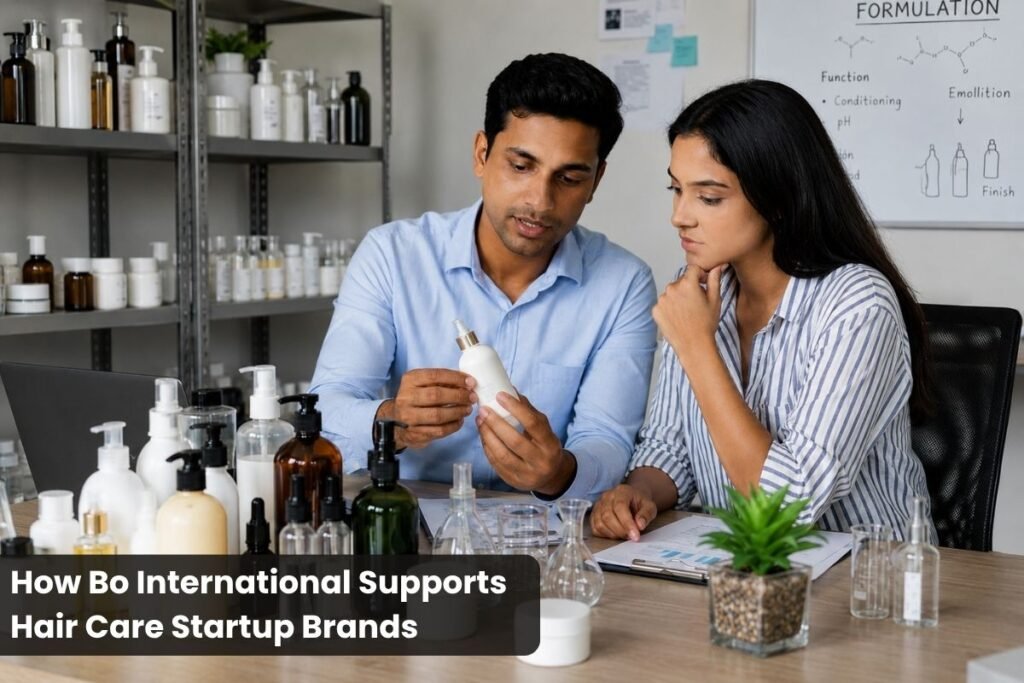
A hair care company’s creation typically begins with a basic concept. It could be a hair shampoo that is specifically designed for a hair issue, a lightweight serum, a nourishing oil or a scalp care product targeted at a specific market.
The process of turning that idea into an actual business is more involved than just choosing the right ingredients and designing appealing packaging.
The founder must consider formulation, positioning of the product and sampling, production quantity, compatibility with packaging pricing, quality and expansion plans for the future. If a startup does not have its manufacturing facilities working with B2B manufacturing partners like Bo International can help connect the original idea of a product to the infrastructure needed for bringing it to market.
Start With The Hair Problem, Not The Product
One of the most important options for a haircare start-up is deciding on what problems the brand would like to address. The mere fact that a shampoo is being launched just because it is a huge segment isn’t enough. The most important thing to consider is to understand the needs of the consumer.
Does the brand target dry hair?
Hair loss?
Frizz?
How can you strengthen your hair?
Curl care?
How do you style your hair?
Daily cleansing?
The result has more influence than the original product. It influences the formulation, packaging pricing, marketing and ultimately the overall assortment of products.
For instance, a company that focuses on the health of your scalp may begin with a shampoo and then expand to the scalp oil, scalp serum or treatment products. A company that focuses on repair might find that shampoo performs best in conjunction along with serum, conditioner, or a masque.
Bo International currently manufactures across different Private Label Hair Care Products including conditioners, shampoos, serums, oils for hair masks, styling products and sprays. Bo International gives startups the chance to consider more than a single product.
Turn The Idea Into a Product Brief
If the problem of the customer is identified, the next step is to translate that problem into a short description of the product.
A well-written brief must answer the practical issues like:
- What is the purpose of the product?
- Who are they intended for?
- What kind of texture should it be?
- Do you think the scent should be evident or not?
- What are the ingredients or claims of the product that have a bearing on the image of the image of the brand?
- What price band is the startup trying to reach?
- What packaging format is most appropriate?
- Is the product sold on its own in a larger selection?
This is because the same product can be developed differently based on the company location.
A shampoo that is sold in mass-market stores and a high-end salon-style shampoo can serve the same purpose but the formulation, texture, scent, packaging and experience could be completely different.
Bo International offers custom formulation as part of its hair care manufacturing services. This allows clients brands to create or modify formulas to meet their specific needs for their product.
In the case of startups it’s a simple lesson: The more concise the brief for the product, the more straightforward it is to make decisions about manufacturing later.
Use Sampling as a Business Checkpoint
The initial sample is more than just a development stage. It also provides an opportunity to determine if the initial business concept is translating into a tangible product.
A formula’s creator should consider more than just whether that formulation “works.”
Considerations to make include:
- Does the texture correspond to the customer you are trying to please?
- Does the scent you are using match?
- Does the product make it easy to use?
- Does the packaging fit the formula?
- Does the product appear to be consistent with the expected price?
- Do you think the founder is comfortable asking his customers to pay for it?
This is crucial especially for companies that are just starting out because early production decisions could affect the limited working capital. Making a decision too quickly can lead to modifications later on, after packaging has been ordered, and production plans have begun. Sampling allows the start-up an opportunity to improve the idea before it commits to bigger quantities.
Think About Manufacturing Before Marketing Gets Expensive
Many founders naturally get enthusiastic about branding their company initially. They start preparing the logo or website, the contents for social media, influencer activities or a launch campaign prior to when the actual product is produced. Manufacturing and marketing have to collaborate in order to grow.
A startup must be aware of:
minimum production quantities,
manufacturing timelines,
packaging options,
sample approval,
product cost,
and reordering
prior to committing fully to a date for launch.
Bo International states that its private-label hair care products are offered to small-scale businesses, with minimum orders starting at 2000 pieces, whereas the exact requirements will depend on the specific product and the manufacturing configuration.
The number is not simply a manufacturing requirement. It’s part of the business strategy.
If a founder purchases 22,000 units, the company should know how quickly these units will sell, where they’ll be kept, how much remaining cash is available for marketing as well as when the following production cycle might be required.
Build The Brand Around More Than One Launch
A startup doesn’t have to introduce ten new products simultaneously. Actually, starting with a smaller, less targeted range could make the initial launch simpler to manage. However, founders must consider where the company might go in the future.
A good first product could be the basis for a broader selection.
For instance:
Shampoo → conditioner → serum
Hair oil → shampoo → mask
Scalp serum → scalp cleanser → treatment oil
Curl shampoo → conditioner → styling cream
This type of development aids the brand in creating an entire customer routine and keeps future launches tied to the initial positioning.
Since Bo International manufactures several different hair-care styles, new brands could develop products in the same manufacturing relationships instead of re-building the supply chain each when the range grows.
Understand The Manufacturer’s Role
A manufacturing partner shouldn’t substitute for the founder’s strategy of business. The founder has to be the owner of the brand’s vision, understanding of the customer positioning, pricing distribution and also marketing.
The role of the manufacturer is different. It’s to assist in turning the idea of a product into something that is made regularly.
Bo International operates as a Third Party Cosmetic Manufacturer and private label company for B2B partners. They provide services such as custom formulations packaging, packaging as well as contract production. The range of hair care manufacturing products offers a range of formats for products and customizable packaging options.
That distinction matters.
Customers might see a bottle that is finished and bears the brand’s name However, underneath that product lies a manufacturing process which involves formulation, production planning, packaging, filling, logistics, and quality systems.
As a founder, deciding on the best manufacturing structure is an essential part of the process of establishing the business, not just purchasing the product.
Plan For Scale Without Losing Focus
The initial production run is crucial, however it shouldn’t be regarded as a finish line. If the product is successful then the company will confront new issues.
Is there a way to increase production?
Does the manufacturer have support for new products?
Will packaging be the same?
Can the business ensure product quality while volumes grow?
Are inventory levels replenished fast enough?
The issues are easier to handle as founders begin to think about the issues before they become more popular.
Bo International states that it is a partner for businesses that launch new brands as well as established brands that are looking to expand and expand their reach. This demonstrates the importance of deciding on a manufacturing facility that can handle more than the initial order.
Final Thoughts
Hair-care businesses start from an idea. But the success of a launch relies on transforming a notion into an item that consumers are able to purchase repeatedly, and an organization that operates continuously.
The founder must be focused on the client branding, its positioning and the longer-term chance. Behind the scenes, a B2B manufacturer can deal with the technical process from formulation through sampling and packaging and production.
For companies that are working with startups like Bo International, the goal is not just to create shampoo, serum and hair oil. It’s about laying the foundational elements that allow the hair-care concept to grow into a viable business and, eventually, a brand that is scalable.