


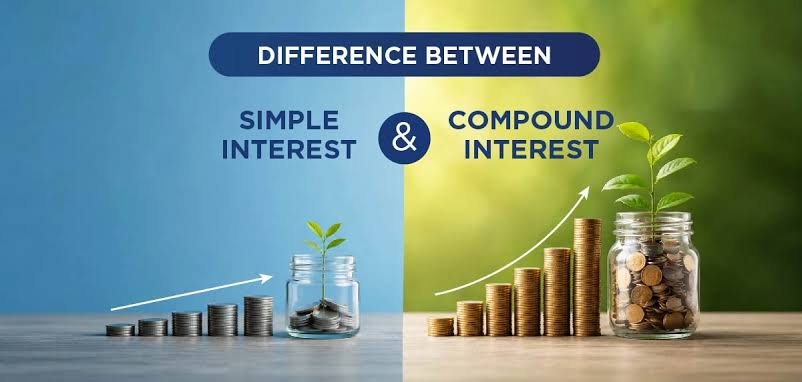
Two savings options can show the same annual rate and still grow to different amounts. The reason may be how interest is calculated. One pays interest only on the amount you started with. The other can pay interest on earlier interest that remains in the account.
Understanding this difference helps you read a product’s terms and test an illustration. A simple interest calculator and a compound interest calculator can show the two paths side by side, provided you give them matching inputs.
What Is Simple Interest?
Simple interest is calculated on the original amount, often called the principal. Imagine you put ₹10,000 into an example that pays 8% simple interest each year. That is ₹800 a year. After two years, you have earned ₹1,600 in interest, bringing the total to ₹11,600.
The amount of interest stays at ₹800 each year in this example because the calculation continues to use the original ₹10,000. You can write it as principal x annual rate x time in years. A simple interest calculator does that arithmetic for you, especially when you want to change the amount or period.
What Is Compound Interest?
With compound interest, previously earned interest is added to the amount on which future interest is calculated. Using the same ₹10,000 and 8% annual rate, the first year still adds ₹800. In the second year, however, 8% is calculated on ₹10,800. That adds ₹864, bringing the total to ₹11,664.
The difference after two years is ₹64. It arises because the first year’s ₹800 also earned interest in the second year. For this to happen, that interest must remain in the balance. If it is paid out and you spend it, the next calculation cannot include it.
The figures shown are for illustrative purpose only
Why Does the Gap Grow Over Time?
Under simple interest, the yearly interest in our example remains ₹800. Under annual compounding, the amount used to calculate interest rises whenever the interest stays invested. More years give that process more chances to repeat, so the difference between the two results generally widens when the rate and other assumptions stay the same.
That is why comparing only the annual rate can be misleading. Check the time period and whether interest is added to the balance. The comparison also assumes that you leave the money untouched. If you withdraw interest as it is paid, it cannot remain in the balance to earn more interest there.
What Does Compounding Frequency Change?
Interest can be compounded yearly, half-yearly, quarterly or at another frequency, depending on the product. More frequent compounding means interest is added to the balance sooner. If the quoted annual rate and all other terms are identical, that can change the amount at the end.
A compound interest calculator may ask you to select a frequency. Choose the one stated in the product’s terms rather than the option that gives the highest result. For a fair comparison, enter the same principal, annual rate and duration in both calculators, then check whether the compound calculation includes the correct frequency.
The calculator is an aid, not a prediction tool. It may provide only an indicative picture.
Where Do These Calculations Help?
The formulas help explain interest-bearing savings and borrowing, but the details of a real product matter. A loan with repayments, for instance, does not keep the original balance untouched for its whole term. A basic simple interest calculator using only the starting balance and number of years may therefore fail to reflect what you actually pay. Look at the repayment schedule and terms when assessing a loan.
Likewise, the word “compounding” is sometimes used while discussing long-term investments. Mutual funds, however, do not pay a fixed rate of interest each year. Their values can rise or fall. A steady line from a compound interest calculator can illustrate how reinvested growth might work, but it should not be mistaken for a mutual fund return forecast.
Compare Results Without Losing the Context
Start with the product’s stated method, rate, period and interest payment rules. Then use the appropriate calculator. If you are comparing two choices, keep the assumptions consistent and look at the final rupee amount as well as the percentage rate.
For longer goals, try different periods to see how time changes the gap between simple and compound interest. You can also change the rate to see how sensitive the result is. These exercises can clarify the arithmetic, but they do not replace reading the terms of the actual product.
The central difference is easy to remember: simple interest is calculated on the original principal; compound interest can be calculated on that principal plus earlier interest kept in the balance. Use a simple interest calculator or compound interest calculator to see what that distinction means for your own numbers.
Mutual Fund investments are subject to market risks, read all scheme related documents carefully.

