


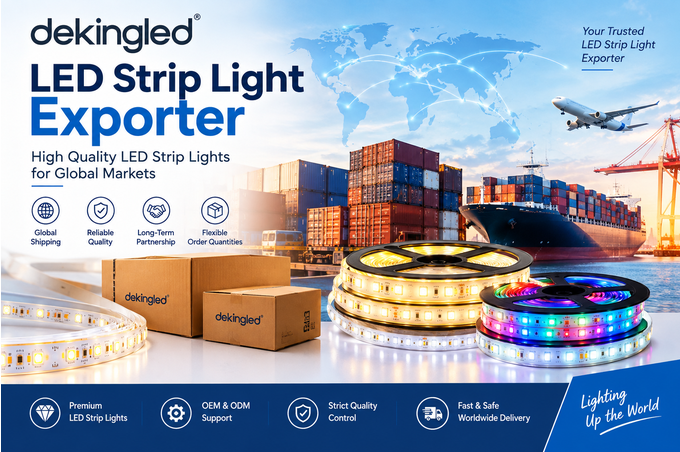
Modern LED installations need more than bright light sources. A successful system requires suitable LED products, correct electrical specifications, appropriate protection, and careful planning. These considerations become especially important for commercial spaces, architectural features, signage, and decorative installations.
Dekingled offers a range of LED lighting solutions for different applications, including cove lighting, architectural lighting, signage backlighting, edge lighting, stores, shopping malls, homes, corridors, staircases, furniture, and show windows.
For projects requiring dependable sourcing, LED Strip Lights exporter options can provide access to different LED technologies and configurations from a dedicated manufacturer.
Selecting the Appropriate LED Technology
Different projects can require different LED designs. Standard SMD strips can provide flexible linear illumination, while COB strips are useful when a smoother appearance is required.
Dekingled’s product range includes 5050, 3528, 2835, 3014, COB, silicone neon, RGB, and RGBW LED products.
The appropriate product should be selected according to the desired lighting effect, installation environment, voltage, power requirements, and physical layout.
COB LED Strips for Uniform Illumination
COB technology can be useful when visible LED points are undesirable. Dekingled describes its COB LED strips as providing uniform, dot-free illumination, creating a smoother visual appearance.
The company also states that COB products can provide easier maintenance and an aesthetically pleasing appearance.
For architectural details, concealed lighting, and applications where a continuous appearance is important, this type of LED technology can be considered.
Understanding Voltage Selection
Voltage is an important part of LED system design. Dekingled provides products operating at different voltages depending on the model.
Its 5050-WW-300 strip supports DC12V/DC24V input, while the 2835 LED strip with 180 LEDs per meter operates at DC24V.
The company also notes that 24V COB strips experience less voltage drop than 12V versions and are suitable for longer runs, while 12V systems can experience progressive brightness loss over distance.
Checking the required voltage before installation helps ensure compatibility between the LED product and its power source.
LED Density and Illumination
LED density can influence how lighting is distributed along a surface. Products with different LED densities may be suited to different installation requirements.
Dekingled’s 2835 product contains 180 LEDs per meter and 900 LEDs per 5-meter reel, while its 3014 product contains 240 LEDs per meter and 1,200 LEDs per 5-meter reel.
The correct density should be considered together with the desired brightness and installation design rather than selected independently.
Waterproof and Protected LED Applications
Environmental conditions can have a significant impact on product selection. Installations exposed to moisture require LED products with appropriate protection.
Dekingled offers products with IP65 and IP68 protection options. Its 2010 Silicone Neon Light has an IP65 rating, while the company’s IP68 waterproof strip is described as remaining impervious to water ingress at a depth of 3 meters.
For outdoor or moisture-prone projects, the protection rating should be reviewed alongside the electrical specifications.
RGB Lighting for Decorative Projects
Commercial and architectural projects sometimes require adjustable colors instead of fixed white illumination. RGB LED technology can provide additional flexibility for decorative and entertainment applications.
Dekingled’s SMD5050 RGB product uses IC2811 technology, RGB output, a 180-degree beam angle, DC12V input, and a 50,000-hour lifespan.
The company’s RGB Touch Controller supports 18 color modes, PWM dimming, 256 gray steps, and 10 intensity levels. It also has 12–24V DC input and a maximum loadable current of 18A.
These features can be useful for installations where lighting effects need to be adjusted according to an event, display, or environment.
Planning Power Requirements
Every LED installation should be evaluated according to its total electrical load. Different products have different power requirements, so the power source needs to be selected after calculating the connected load.
For example, Dekingled’s 5050-WW-300 strip has a maximum power of 72W, while its 3014 LED strip has a maximum power of 12W per meter.
The power requirements should be calculated for the complete installation rather than relying on the rating of a single section.
Applications Across Commercial Spaces
LED strips can be used in many areas of commercial and architectural environments. Dekingled identifies applications including high-end stores, shopping malls, homes, cars, corridors, staircases, furniture, show windows, bars, KTV venues, cafes, stages, beauty salons, crafts, and high-end counters.
This flexibility allows LED products to be integrated into both functional and decorative lighting designs.
Choosing a Suitable Product Configuration
A Custom LED Strip Manufacturer can be relevant when a project requires particular specifications or configurations. Before selecting a product, buyers should review the voltage, LED density, power rating, dimensions, protection level, and intended installation environment.
Dekingled’s product information includes options such as 5-meter reels, 3M adhesive backing, different PCB dimensions, multiple color choices, and various cutting configurations, depending on the product.
These specifications can help installers match the product configuration with the physical requirements of the project.
Final Thoughts
Reliable LED system design depends on selecting products that match the application’s electrical, environmental, and visual requirements. Voltage, power consumption, LED density, protection, and lighting technology should all be considered before installation.
With options covering SMD, COB, RGB, RGBW, silicone neon, and different LED densities, Dekingled provides a range of products for architectural, commercial, signage, decorative, and display applications.

