


Ask any experienced modular process skid manufacturer what a healthy plant sounds like, and you’ll get a surprisingly detailed answer. A steady hum is good. A rattle, a squeal or a sudden bang usually isn’t.
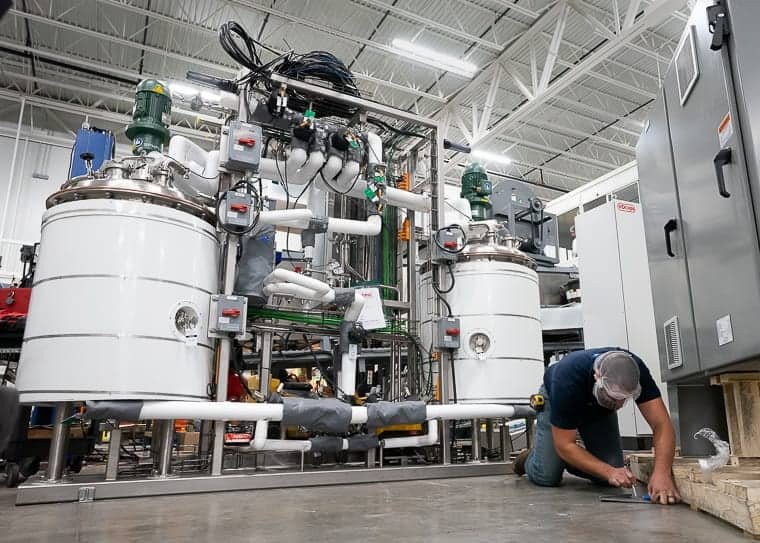
A modular process skid is a compact, factory-built piece of an industrial plant. Pumps, tanks, pipes, valves and sensors are all packed onto one steel frame. Once it’s running, it makes noise all day long, and that noise is full of clues.
Think of this article as a sound effects library for industrial equipment. Here’s what each sound means and why engineers care.
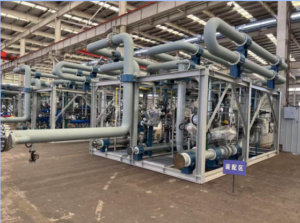
Every pipe, valve and support on a skid like this one can become a source of noise or vibration, so good builders plan for sound from the start.
The Hum: What “Healthy” Sounds Like
A well-built skid isn’t silent. It sounds steady.
Electric motors give off a low, even hum. Liquid moving through pipes makes a soft rushing sound, a bit like the plumbing in a house. Nothing changes much from one minute to the next.
“Steady” is the key word. Operators who walk past the same equipment every day learn its normal voice. When that voice changes, they notice, often before any alarm goes off.
The Gravel Rattle: A Pump in Trouble
If a pump starts to sound like it’s full of gravel or marbles, it’s probably suffering from cavitation.
Here’s what happens. When the pressure at the pump’s inlet drops too low, the liquid forms tiny vapor bubbles. As those bubbles move into higher-pressure areas, they collapse, thousands of times per second. Each collapse sends out a tiny shock wave, and together they make that crackling rattle.
It’s not just annoying. Over time, those shock waves eat small pits into the pump’s metal parts.
On a skid, designers prevent cavitation mostly through layout. They keep the pump inlet short and simple, place tanks high enough above the pump, and avoid sharp bends right before it. Because everything is squeezed into a small frame, these details matter even more.
The Squeal: Bearings Asking for Help
A high-pitched squeal or whine from a motor or pump often means its bearings are worn, dry or out of line.
By the time a person can hear it, though, the problem is already fairly advanced. That’s why many plants use vibration sensors. They pick up tiny changes in how a machine shakes, often weeks before the sound becomes audible. It’s a bit like a doctor spotting a heart problem on a scan before the patient feels anything.
The Hiss You Can’t Hear: Gas Leaks
Some of the most important sounds on a skid are ones no human can hear.
When gas escapes through a tiny crack or a loose fitting, it creates turbulence, and that turbulence produces ultrasound. Human hearing tops out at around 20 kHz, and this sound sits well above that. Handheld ultrasonic leak detectors, many of which work at around 40 kHz, pick it up and turn it into a hiss you can hear through headphones. A technician can then follow the sound straight to the leak.
This matters most with hydrogen. Hydrogen is the smallest molecule there is, so it can slip through gaps that would hold almost any other gas. It has no smell, and a hydrogen flame is nearly invisible in daylight.
That’s why careful builders hunt for leaks long before a skid reaches the customer. Sharp Eagle, a manufacturer that has built hydrogen test skids for energy research, checks valves, flanges, welds and instrument connections for hydrogen tightness as part of its factory testing.
The Bang: Water Hammer
You may have heard this at home: you shut a tap quickly and the pipes knock. That’s water hammer, and in industry it can be much stronger.
When fast-moving liquid is stopped suddenly, for example by a valve slamming shut or a pump switching off, it sends a pressure wave racing back through the pipe. The result is a loud bang. Sometimes the pressure spike is high enough to damage pipes, supports or instruments.
Engineers tame it with slower-closing valves, carefully planned pump start and stop sequences, and devices that absorb the pressure surge.
The Scream: Valves Under Pressure
Some control valves have to drop high-pressure gas to a much lower pressure in a very small space. When that happens, the gas can speed up enough to make a piercing, whistling scream.
The fix is usually inside the valve. Special “low-noise trims” split the flow into many small streams and lower the pressure step by step instead of all at once.
The Shudder: Pipes That Won’t Sit Still
Not all noise comes from moving parts. Pipes themselves can shake.
Piston-type compressors push gas in pulses, a bit like a heartbeat. Those pulses travel through the pipes and can make them vibrate. The weak spots are often the small branch pipes that connect gauges and sensors. After months of shaking, they can crack where they join the main pipe.
On a compact skid, where pipes are short and packed tightly together, engineers add extra supports, fit pulsation dampers and brace small connections so they don’t become weak links.
The Drone: How Loud Is Too Loud?
Even a perfectly healthy skid can be loud enough to damage hearing over time.
In the United States, OSHA requires a hearing protection program once workers are exposed to an average of 85 decibels over an eight-hour shift. Many projects therefore set a limit of around 85 dB(A), measured about one meter from the equipment.
Decibels can be tricky. Every 3 dB increase doubles the sound energy, and roughly 10 dB more sounds about twice as loud to the human ear. So cutting just a few decibels makes a real difference.
Common solutions include acoustic enclosures around compressors, silencers on vents and slower-running motors where possible.
Listening to a Modular Process Skid Before It Ships
One big advantage of a modular process skid is that it can be tested in the factory before it goes anywhere. During the Factory Acceptance Test, pumps and valves are usually run with water, and the whole system is pressure-tested.
This is also the perfect time to listen. A strange noise, a shaking pipe or a whistling valve is far easier to fix on the shop floor than at a remote site. Some teams also record baseline vibration readings at this stage, so they have a “healthy voice” to compare against later.
What This Means for You
You don’t need to be an engineer to take something useful from this. If you buy, run or simply work near industrial equipment, three questions go a long way:
- Was noise considered in the design, or added as an afterthought?
- Was the equipment run, and listened to, before delivery?
- Do regular maintenance checks include vibration and leak testing?
Every machine has a voice. The best plants are the ones where someone is actually listening.

